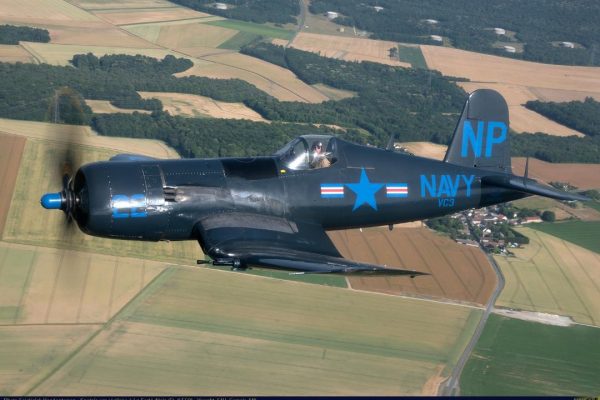
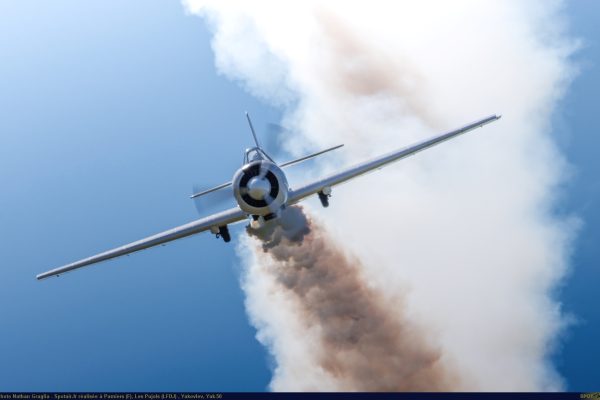
The T-28 A Trojan is a training aircraft built by North American Aviation for the US Air Force. The model A is powered by a 7-cylinder Wright R-1300 Cyclone engine producing 800 hp, with a two-blade propeller.
Its first flight was on January 20, 1950. In 1952, the Navy requested a more suitable version, the T-28B, which featured a 1,425 hp R-1820 engine, a three-blade propeller, and a ventral airbrake. In 1958/1959, the French Air Force, engaged in counterinsurgency during the Algerian War, selected the T-28B, but it was no longer in production. Instead, Pacific Airmotive reconditioned surplus T-28A aircraft with engines of 1,300 or 1,425 hp. The French Air Force acquired about 150 T-28A airframes.
Based mainly in Toulouse, Sud-Aviation adapted them by equipping them with R-1820 engines (recovered from surplus B-17s) and the B-version propeller, adding underwing weapon mounts and combat protections for the crew. This French version, called Fennec, could carry four 120 kg bombs, four 12.7 mm machine guns, two rocket pods with seven rockets each, or any combination of these weapons.
More Feared Than B-52s
The Americans also used the T-28 during the secret war in Laos to destroy enemy troop concentrations, particularly artillery positions. The T-28s were more feared than the louder B-52s, which allowed people to take cover before bombing. Nicknamed "Lap Kat" ("cut wings"), the T-28s flew at low altitudes and were difficult to detect. Equipped with napalm bombs, they caused significant destruction during the civil war.
On the ground, the T-28 appears bulky, but in flight, it is very homogeneous and can perform all basic combat and aerobatic maneuvers.
This aircraft is very popular among enthusiasts, with an excellent cost/performance ratio and performance close to the P-51D Mustang. There are about fifteen in France.
"The aircraft presented at the Carcassonne air show is a T28-A with a Cyclone 1300-1B engine. It was ordered in 1949, the 37th in the series, used for advanced fighter pilot training, and sold to civilians in February 1962. Since then, it has had various owners and arrived in France in October 2020," says its pilot Loïc Domain from Castelnaudary.
Technical Specifications
Maximum speed: 550 km/h; Range: 1,700 km
Takeoff weight: 3,855 kg; Wingspan: 12.22 m; Length: 10.06 m
Photo Credit: Spot’Air